
Meta Description: 9 Fast Printer Guide fixes to solve the most common printer errors quickly. Stop wasting time — get your printer working again in minutes with these easy steps.
9 Fast Printer Guide Fixes for Common Printer Errors
Printers are one of those things you never think about — until they don’t work when you need them the most. You’re in the act of printing something important, and suddenly you’re confronted by an error message, a blinking light, or a blank page coming out of the tray.
Sound familiar?
The good news is that most printer problems aren’t as dire as they seem. In reality, most common printer errors can be repaired in a matter of minutes without summoning a technician or paying for repairs.
This printer guide provides step-by-step instructions for nine rapid, reliable fixes to the most maddening printer problems. Paper jam, printer stuck offline, printing that’s faded — and a connection that won’t work — this guide is here for you.
Let’s get your printer working again.
Why Printers Go Haywire in the First Place
Before diving into fixes, it helps to understand why printers misbehave. Most errors can be reduced to a few root causes:
- Outdated or corrupted drivers
- Paper loaded incorrectly
- Low or empty ink/toner cartridges
- Wireless connection drops
- Clogged print heads
- Overloaded print queues
- Firmware that hasn’t been updated
Identifying the root cause makes a remedy much simpler. Now, let’s break them down one by one.
Fix 1: What to Do If Your Printer Says “Offline”
This is one of the most common complaints people have. Your printer appears to be “offline” on your computer, although it’s powered up and connected.
Why This Happens
Your computer and printer broke their connection to one another. It can occur following a Wi-Fi drop, a restart, or a settings change.
Steps to Fix It
Step 1: Open Start and head to Settings → Devices → Printers & Scanners.
Step 2: Choose your printer and select Open Queue.
Step 3: In the menu, click Printer and ensure that “Use Printer Offline” is NOT checked.
Step 4: Reboot your printer and computer.
Step 5: If it still shows offline, remove the printer from the list and then add it fresh.
This solution works for offline errors about 80% of the time. It’s simple, fast, and free.
Fix 2: Paper Jams — Clearing Them the Right Way
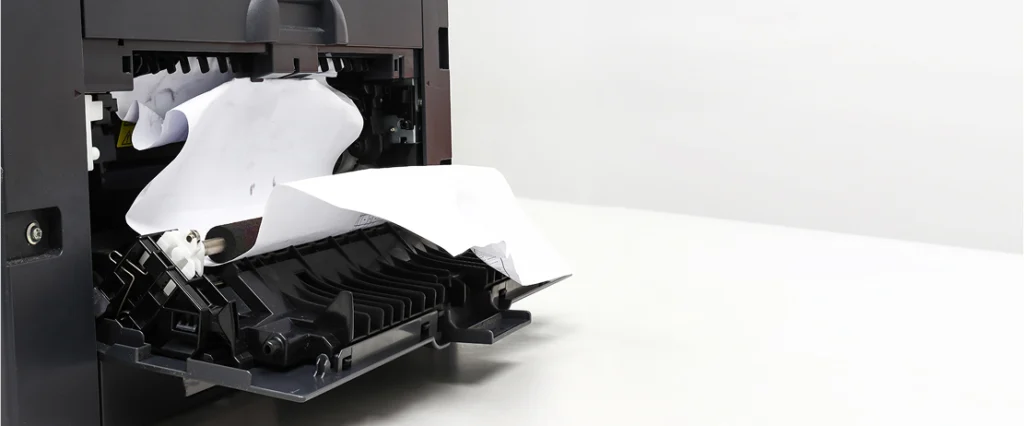
Paper jams are practically a rite of passage with printers. But yanking the paper out incorrectly can ruin rollers or leave shredded bits stuck inside.
Do This Before Anything Else
Before you attempt to remove jammed paper, turn the printer off. This protects both your safety and the machine.
The Proper Way to Remove a Paper Jam
- Open all access panels — front, back, and the tray area.
- Shine a flashlight and look closely if necessary.
- Gently pull the paper in the direction that it was feeding.
- Never yank or pull backwards — this rips the paper and jams it harder.
- Look for small torn pieces left behind. Just a scrap of paper can trigger the next jam.
- Close all panels and power it back on.
Preventing Future Jams
| Common Cause | Easy Fix |
|---|---|
| Overfilled paper tray | Fill tray only to the marked line |
| Mixed paper sizes | Use the same size of paper |
| Wrinkled or damp paper | Store in a flat, dry place |
| Worn rollers | Clean the rollers monthly with a damp cloth |
Fix 3: Prints Are Faded or Streaky
You send a document off to print, and it comes out looking washed out, striped, or barely visible. Try these steps first before purchasing new ink.
Check Your Ink or Toner Levels
Most printers have a native utility to show ink levels. On Windows, head to Devices and Printers, right-click your printer, and select Printer Properties or Printer Preferences. Look for an “Ink Levels” tab.
If the levels are fine, the problem is most likely a clogged print head.
How to Perform a Print Head Cleaning Cycle
The vast majority of inkjet printers have a self-cleaning function. Here’s how to use it:
- On Windows: Printer Properties → Maintenance → Clean Print Heads
- On Mac: System Preferences → Printers & Scanners → Options & Supplies → Utility → Clean Print Heads
- On the printer itself: Many have a dedicated button combo — check your manual
Run the cycle once, then print a test page. If it’s still streaky, run it one more time. Don’t run it more than twice in a row — it burns ink.
When to Replace the Cartridge
If cleaning doesn’t help and levels are low, it’s time for a new cartridge. To prevent compatibility issues, always use cartridges that are recommended for your specific model.
Fix 4: Printer Driver Problems — Update or Reinstall
Drivers are the software that allow your computer to “talk” with your printer. When they become outdated or corrupted, things can go off the rails quickly.
Signs That You Have a Driver Problem
- Printer was working, then just stopped all of a sudden
- Error messages with “driver” in the name
- Print jobs stuck in the queue with no explanation
- Your printer won’t even show up on your computer
How to Update Your Printer Driver
On Windows:
- Right-click the Start button and select Device Manager
- Expand the Printers section
- Right-click your printer and select Update Driver
- Choose Search Automatically for Updated Driver Software
Alternatively, head directly to your printer manufacturer’s website (HP, Canon, Epson, Brother, etc.) and download the latest driver for your specific model.
How to Do a Clean Reinstall
Sometimes updating isn’t enough. A fresh reinstall works better:
- Go to Settings → Devices → Printers & Scanners
- Choose your printer and click Remove Device
- Download the most recent driver from the manufacturer’s site
- Run the installer and complete all setup steps
- Restart your computer when finished
Fix 5: Wi-Fi Printing Not Working
Wireless printing is great — until it’s not. Connection issues are very common, particularly after router changes or software updates.
Quick Checklist First
Before you dive deep, here’s a fast checklist:
- ✅ Confirm that your printer is on the same Wi-Fi network as the computer
- ✅ Is your printer sitting in a location with a strong Wi-Fi signal?
- ✅ Has the router been restarted recently?
- ✅ Has your router’s password changed recently?
If you answered no to any of these, start there.
Reconnecting Your Printer to Wi-Fi
Step 1: On the printer display panel, navigate to Network Settings or Wireless Setup Wizard.
Step 2: Click on your network name (SSID) and type the password.
Step 3: Look for confirmation of the connection — usually a solid Wi-Fi icon.
Step 4: Print a test page to be sure.
Still Not Connecting? Try This
- Temporarily move the printer closer to the router to test if distance is a problem
- Use a wired Ethernet connection as a short-term fix
- Give your printer a static IP address to keep it from dropping off the network
For more detailed wireless troubleshooting steps, visit Printer Troubleshoot Guide — a dedicated resource for solving all kinds of printer connection issues.
Fix 6: Print Jobs Stuck in the Queue
You hit print, nothing comes out, and now there are 12 jobs backed up in the print queue going nowhere. This is a classic case of printer pain.
Why the Queue Gets Stuck
A single failed print job can gunk up everything that comes after it. The “Print Spooler” — the service that manages print jobs — sometimes gets stuck and needs to be reset.
How to Clear Print Jobs Manually
Option A — Via the Queue Window:
- Open Devices and Printers
- Double-click your printer to open the queue
- Right-click each job and select Cancel
- Wait a moment and try printing again
Option B — Through Services (More Effective):
- Press Windows + R, type services.msc, and hit Enter
- Scroll down to Print Spooler
- Right-click and select Stop
- Open File Explorer and navigate to:
C:\Windows\System32\spool\PRINTERS - Delete all files in that folder (do NOT delete the folder itself)
- Go back to Services, right-click Print Spooler, and choose Start
- Try printing again
This approach clears stuck jobs at the system level and works very reliably.
Fix 7: Printer Printing Blank Pages
You send something to print and nothing but white paper comes out. This one is especially confusing.
The Most Likely Causes
| Cause | Solution |
|---|---|
| Ink cartridge is empty | Replace cartridge |
| Protective tape not removed from new cartridge | Remove the tape and reinstall |
| Print head is severely clogged | Run 2 cleaning cycles |
| Wrong paper settings in the document | Match paper size in print settings |
| Corrupted print job or document | Try printing a different document |
Test It Fast
Open a simple text document — Notepad on Windows, for example — type a few words and print it. If that prints fine, your original document or its formatting is causing the issue, not the printer.
If the test page is also blank, there’s a hardware issue — probably an empty or incorrectly seated cartridge.
Reseating the Cartridge
- Open the cartridge compartment
- Remove each cartridge
- Lightly wipe the copper contacts with a dry lint-free cloth
- Push back in until you hear a click
- Run a test print
Fix 8: Printer Making Strange Noises
Grinding, clicking, or squeaking during printing are not normal and typically indicate a mechanical problem.
What Different Sounds Mean
Grinding noise: Something is stuck in the rollers — probably a small piece of paper or debris. Shut the printer down and inspect thoroughly.
Clicking sound: Usually caused by a paper jam that wasn’t fully cleared, or a cartridge that wasn’t mounted properly.
Squeaking: Rollers may be dry or worn. A light application of roller cleaning solution can help, but worn rollers typically need to be replaced.
Loud thumping: The paper tray is not seated properly, or a cartridge carriage is hitting an obstacle.
What to Do
- Turn off the printer immediately as soon as you hear any strange sounds
- Open all panels and inspect for debris or misaligned parts
- Make sure cartridges are properly installed
- Ensure the paper tray is securely in place
- If sounds persist after clearing any obstructions, contact the manufacturer’s support
Fix 9: Printer Setup Errors on a New Computer
Just got a new computer and your printer doesn’t work all of a sudden? This is very common when switching from one device to another or after a Windows or macOS update.
The Most Common Setup Mistakes
- Expecting the printer to connect automatically (it often doesn’t)
- Using a driver from a disc that came with the printer (almost always out of date)
- Running the setup without Admin privileges on Windows
How to Set Up Your Printer the Right Way
Step 1: Go to the official site of your printer manufacturer.
Step 2: Navigate to Support → Downloads and search for your specific printer model.
Step 3: Download the full driver and software package — not just the basic driver.
Step 4: Run the installer. On Windows, right-click and select Run as Administrator.
Step 5: Follow all on-screen steps, including connecting the printer when prompted.
Step 6: Print a test page after setup is complete.
Bonus Tip for Mac Users
On macOS 13 and newer, go to System Settings → Printers & Scanners → Add Printer. Usually, macOS automatically downloads the appropriate driver from Apple’s database. Otherwise, use the driver package from the manufacturer.
According to HP’s official support documentation, keeping your printer drivers and firmware up to date is one of the most effective ways to prevent recurring printer errors.
Quick Reference: Printer Error Codes and What They Mean
| Error Code / Message | What It Means | Quick Fix |
|---|---|---|
| “Printer Offline” | Connection lost | Check network, toggle offline mode |
| “Paper Jam” | Paper stuck inside | Clear jam, check for torn pieces |
| Error Code E02/E03 | Paper feed issue | Reload paper, clean rollers |
| “Low Ink” warning | Ink running out | Replace cartridge soon |
| “Driver Unavailable” | Driver corrupted or missing | Reinstall driver |
| “Spooler Error” | Print queue frozen | Reset Print Spooler service |
| Blinking lights (all) | General error state | Power cycle the printer |
How to Keep Your Printer Running Smoothly
Prevention is better than curing. Develop these habits to limit how often you encounter printer problems:
Print regularly. Send a test page once a week even if you don’t have something to print. This prevents ink from drying inside the nozzles.
Use quality paper. Lower-cost or lower-quality paper leads to more jams and can damage rollers over time.
Keep it dust-free. Cover the printer with a cloth when not in use. Dust inside a printer causes all kinds of problems.
Update firmware. Printer manufacturers release firmware updates that fix bugs. Check for updates every few months through the printer’s settings menu or the manufacturer’s website.
Don’t let ink run completely dry. Replace cartridges soon after seeing a low ink warning. On some inkjet printers, printing on empty cartridges can ruin the print head permanently.
FAQs: Common Printer Questions Answered
Q: My printer says it’s offline, but I have it turned on. Why? A: That typically means the connection between your computer and printer has failed. Go to your printer settings and check if “Use Printer Offline” is enabled; disable it. Often, just restarting both devices fixes this issue.
Q: How do I troubleshoot a printer that prints blank pages? A: First, check your ink or toner levels. If those are fine, try removing and reseating the cartridges. Examine new cartridges for protective tape that may not have been removed. Then run a print head cleaning cycle.
Q: Is it OK to use third-party ink cartridges? A: Third-party cartridges are perfectly fine and much less expensive. However, quality varies between brands. Low-grade refill cartridges can plug up print heads or create patchy results. If you go that route, stick to well-reviewed third-party brands.
Q: Why does my printer jam even with new paper? A: Paper jams with new paper often come from overfilling the tray, mixing paper sizes, or worn rollers. Be sure the tray is not filled beyond the max line and that the paper guides snugly butt up against the paper stack.
Q: How frequently do I need to clean my printer? A: For home use, a light external clean once per month is sufficient. Perform a print head cleaning cycle every 2–3 months, or when you notice faded prints. Wipe the rollers about every 3–6 months using a lightly damp lint-free cloth.
Q: It was fine yesterday — why is my printer not printing today? A: The most frequent overnight offenders are: a print job stuck in the queue, a lost Wi-Fi connection, or a Windows/macOS update that broke the driver. Check the print queue first, then the connection, then the driver.
Q: How can I restore printing to a connected printer that won’t print? A: Clear the print queue, restart the Print Spooler service on Windows, and reboot both the printer and computer. If that fails, remove and reinstall the printer using the newest driver.
Wrapping It Up
Printer problems can seem daunting when they happen — particularly when you’re in a rush. But as this printer guide demonstrates, most standard problems can be fixed with simple steps you can do yourself.
Here’s a quick recap of all 9 fixes:
- Fix the “offline” status through printer settings
- Clear paper jams safely by following the correct steps
- Perform a print head cleaning for faded or streaky prints
- Update or reinstall printer drivers
- Reconnect your printer to Wi-Fi the right way
- Clear stuck jobs by resetting the Print Spooler
- Resolve blank pages by reseating cartridges
- Investigate strange sounds before they turn into bigger issues
- Set up your printer correctly on a new computer
Most of these fixes take 10 minutes or less. Bookmark this guide for the next time your printer goes haywire. With a bit of patience and the right steps, you’ll rarely need to call for professional help.