
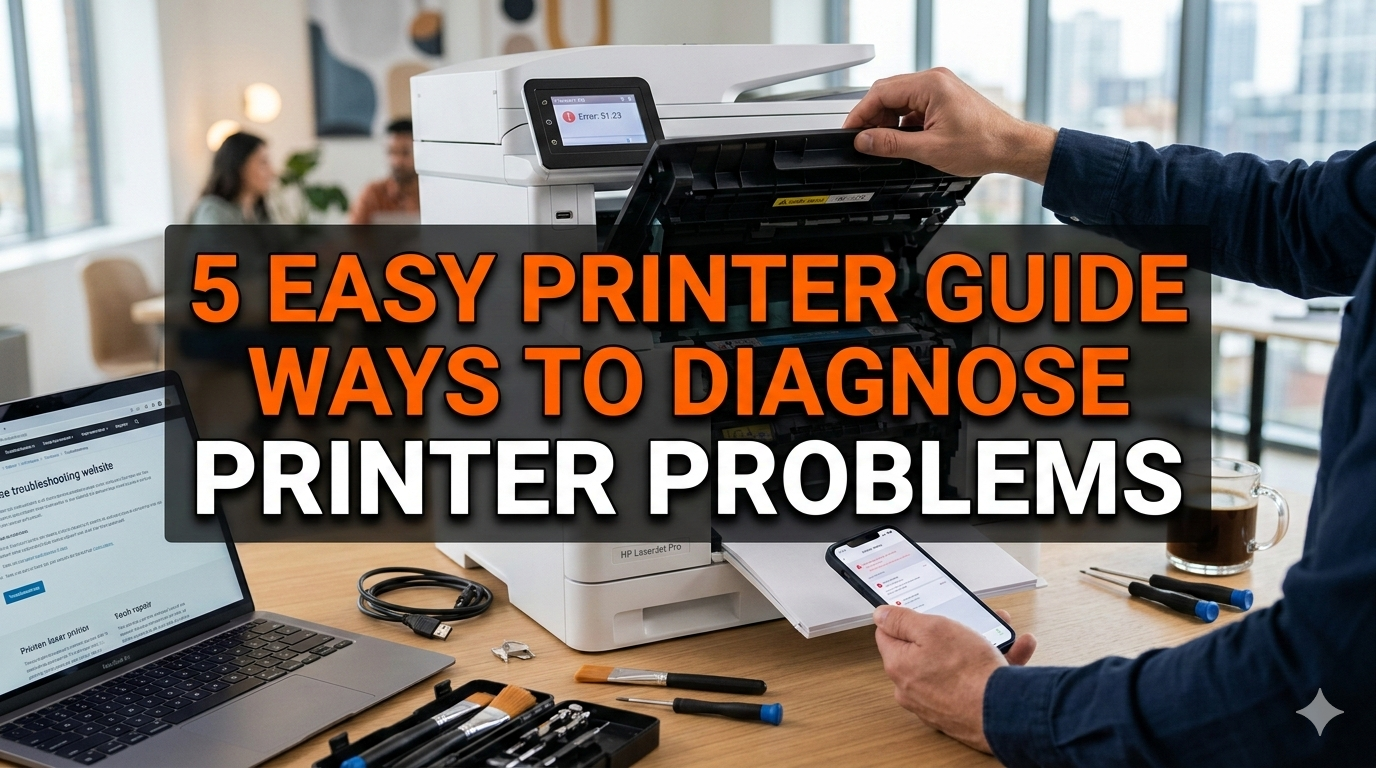
Meta Description: 5 Easy Printer Guide ways to diagnose printer problems fast. Learn simple steps to fix common issues and get your printer working again today.
5 Easy Ways to Diagnose Printer Issues
Are you having issues with your printer again? You’re not alone. Printers are among the most frustrating devices in any home or office. One minute they work perfectly. The next, they decline to print a single page.
The good news? Most printer issues are easier to fix than you might imagine. You don’t have to be a tech wizard. All you need are the right steps.
This guide takes you through 5 simple printer guide ways to diagnose printer problems — step by step, in plain language. This guide has you covered whether your printer’s offline, printing blank pages, or making weird noises.
Let’s get into it.
Why It Matters to Diagnose Printer Problems the Right Way
When their printer breaks, most people make the same mistake. They restart it once, throw up their hands and call for costly tech help. Or even worse — they buy a new printer when the old one just needed something simple.
Learning to diagnose the problem yourself saves time, money, and a ton of stress.
Most printer problems generally fit into a few fundamental categories:
- Connectivity Problems (printer isn’t connecting to your device)
- Hardware Issues (paper jams, cartridge errors)
- Software or Driver Issues (outdated or non-existent drivers)
- Print Quality Problems (blurry, faded, or streaky prints)
- Configuration Errors (incorrect settings or incorrect default printer selected)
After knowing the type of problem your printer has, you can easily debug it. That’s precisely what this guide helps you accomplish.
Tip #1 — Start With the Basics
It sounds so simple, but please listen to this. Many, many printer issues are solved simply by checking the simplest of things first.
Start With the Physical Setup
Before you start poking around in software settings or calling tech support, do a quick physical check:
- Is the printer turned on and connected?
- Are all cables connected firmly (if using a wired printer)?
- Is there paper in the tray?
- Is the ink or toner cartridge correctly seated?
- Are there any flashing warning lights on the printer panel?
These might seem like no-brainers. Yet a surprising share of service calls have turned out to be something as mundane as a loose cable or an empty paper tray, said printer repair technicians.
Restart Everything
Make sure the physical setup appears fine and restart both the printer and computer. Power off the printer completely — not sleep mode. Wait 30 seconds. Then turn it back on.
Repeat this process with your computer. This clears away temporary errors that tend to accumulate in the system’s memory.
Check the Ink or Toner Levels
Low ink or toner is a very common culprit. Most printers have a display or software tool that will show ink levels. Check this before moving on.
| Common Basic Issue | Quick Fix |
|---|---|
| Printer not turning on | Check power cable and outlet |
| No paper feeding | Refill paper tray, fan the stack |
| Cartridge error | Remove and reinsert cartridge |
| Blinking lights | Check printer manual for error codes |
| Printer freezing | Restart printer and computer |
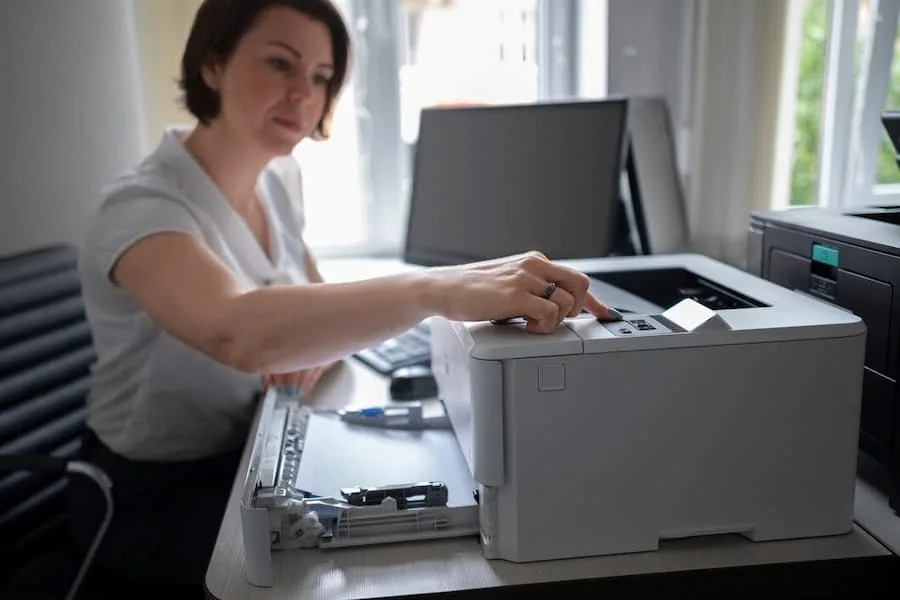
Way #2 — Troubleshoot Network Issues (Wired and Wireless)
One of the top sources of printer problems today is connectivity — especially with wireless printers. When your printer is listed as “offline” or your computer cannot find it, the connection is most often the problem.
Is It a Wi-Fi Problem?
For wireless printers, start here:
- Check that the printer is connected to the right Wi-Fi network. Most homes now have more than one network (like a 2.4GHz and a 5GHz band). Your printer might be on a different one than your computer.
- Check the Wi-Fi signal strength. If the printer is far from the router, it may be out of range and thus within a weak signal.
- Restart your router along with the printer and computer.
Is It a USB Problem?
If you’re connected by USB:
- Use another USB port on your computer.
- If you can, try a different USB cable.
- Do not connect it via a USB hub — plug the printer directly into the computer.
How to Check the Printer Status on Your Computer
On Windows:
- Open Settings > Devices > Printers & Scanners
- Locate your printer and check if it shows “Offline”
- Right-click and choose “See what’s printing”
- Make sure no print jobs are stuck in the queue — clear them
On Mac:
- Navigate to System Settings > Printers & Scanners
- Check if the printer shows as idle, paused, or offline
- Remove stuck jobs from the print queue
Run the Built-In Troubleshooter
Windows includes an automated printer troubleshooter that resolves many connectivity problems on its own. Go to Settings > System > Troubleshoot > Other Troubleshooters and run the Printer troubleshooter.
It won’t solve everything, but it takes care of a solid chunk of everyday problems with zero technical skills necessary.
💡 Pro Tip: For more step-by-step printer fixes and guides, visit Printer Troubleshoot Guide — a dedicated resource for solving all kinds of printer problems quickly and easily.
Way #3 — Check for Driver and Software Issues
This is where many people hit a wall. Printer drivers are the programs that allow your computer to communicate with your printer. If those drivers aren’t up to date, or are missing altogether, or corrupted — even if everything else is working perfectly well — your printer won’t work at all.
How to See If Your Driver Is the Issue
Some signs that you may have a driver problem include:
- Printer is connected but print jobs are not going through
- Error messages mentioning “driver unavailable”
- Printer worked perfectly until a recent Windows/Mac update
- Printer shows up in device list but with a yellow warning icon
Updating or Reinstalling Your Printer Drivers
Step 1: Visit the official website of your printer’s manufacturer (HP, Canon, Epson, Brother, etc.).
Step 2: Find the support or downloads section. Enter your printer model number.
Step 3: Download the latest driver for your operating system.
Step 4: Install the new driver. If an old driver caused trouble, uninstall it first before installing the new one.
On Windows, you can uninstall drivers through: Control Panel > Devices and Printers > Right-click your printer > Remove device
Then reinstall fresh.
Don’t Forget Firmware Updates
Firmware is distinct from a driver — it’s the internal software that actually lives inside the printer itself. It is common for manufacturers to issue firmware updates to patch bugs and enhance performance. Check your printer’s settings menu or the manufacturer’s website for a firmware update.
| Driver Issue Sign | What It Means | Fix |
|---|---|---|
| “Driver unavailable” error | Missing or broken driver | Reinstall the driver |
| Yellow warning icon | Driver conflict or outdated | Update the driver |
| Works on one device, not others | Device-specific driver issue | Install driver on that device |
| Stopped working after OS update | Compatibility issue | Download updated driver |
Way #4 — Diagnose Print Quality Problems
Your printer is technically working — it’s printing — but the output looks terrible. Streaky lines, faded text, wrong colors, or blank pages. These are print quality issues, and there are a number of causes for these.
Blank Pages Coming Out?
This is one of the most common and also confusing issues. Your printer feeds paper through but prints nothing. Here’s what to check:
- Ink cartridge is empty. It may not be enough even if the indicator shows a bit of ink.
- Protective tape not removed. New cartridges have a thin plastic tape over the nozzle. If you forgot to remove it, nothing will print.
- Ink has dried out. If you don’t use the printer for a long time, the ink may dry and clog the nozzle.
Streaky or Faded Prints?
This typically indicates a clogged printhead or low ink. Most modern printers have a built-in cleaning cycle you can run through the settings menu.
On most printers:
- Find the printer settings or maintenance menu
- Look for “Clean Printhead” or “Nozzle Check”
- Run a cleaning cycle and print a test page
If it still appears faded after 2 or 3 cleaning cycles, you may need to replace your cartridge.
Wrong Colors Printing?
If colors appear off — such as photos printing with a green cast or skin tones turning orange — the problem is usually:
- An individual ink cartridge is depleted or low
- The color profile on your computer is set incorrectly
- The paper type setting does not match the paper you are using
Always set the paper type in your print settings to match the actual paper in the tray. Glossy photo paper requires different settings than regular office paper.
Lines, Smears, or Dots on Prints?
These usually mean the printhead is dirty or the paper is slightly damp. Try:
- Running the printhead cleaning tool
- Using fresh, dry paper
- Making sure there are no scraps of torn paper stuck inside
Way #5 — Troubleshoot Paper Jams and Mechanical Issues
Paper jams are the classic printer nightmare. But mechanical problems can go beyond just jams. Grinding noises, sideways paper feeding, or the printer simply refusing to pull any paper at all — these problems all fit into this category.
How to Properly Clear a Paper Jam
The last thing you want to do is violently yank the paper out. That may rip it and leave fragments behind, complicating the situation.
Here’s the safe method:
Step 1: Turn the printer off completely. Don’t just pause it.
Step 2: Open all access panels — front, back, and the cartridge area if possible.
Step 3: Carefully pull the paper in the direction it was traveling (forward, not backward). Use both hands for even pressure.
Step 4: Search each panel and compartment for tiny torn pieces. Even a little scrap can cause another jam.
Step 5: Reassemble, switch the printer back on, and print a test page.
Paper Feeding Problems
If the printer continues to pull multiple sheets at once or is unable to pick up paper at all, the problem is typically with the pick rollers — small rubber wheels that grab sheets from the tray.
- Ensure the paper stack is not too thick (consult the maximum capacity your printer can hold)
- Fan the stack of paper before loading to prevent sheets from sticking together
- Set the paper guides so that they just lightly touch the edges of the stack
- If the rollers appear worn or shiny, wipe them down with a damp cloth or replace them
Strange Noises From the Printer
| Noise Type | Likely Cause | What to Do |
|---|---|---|
| Grinding or clicking | Paper jam or foreign object | Check all compartments |
| Loud humming | Mechanical issue or stuck roller | Restart and check for obstructions |
| Beeping | Error code alert | Check display for error message |
| No sound at all | Power or motor issue | Check power supply |
When to Seek Professional Help
Some mechanical issues go beyond what a home mechanic can handle. Consider professional service if:
- Printer makes grinding sounds even after clearing jams
- The printhead carriage gets stuck and won’t move
- The printer powers on but nothing happens at all, even after reinstalling drivers
- Internal parts such as rollers or gears are visibly broken
Quick Reference: Printer Problem Diagnosis Chart
| Problem | Likely Cause | Solution |
|---|---|---|
| Printer is offline | Connectivity or Wi-Fi problem | Restart printer and router |
| Blank pages printing | Empty ink or clogged nozzle | Check ink levels, run cleaning |
| Poor print quality | Low ink or dirty printhead | Run printhead cleaning cycle |
| Paper jam | Overloaded tray or worn rollers | Gently remove paper, check all compartments |
| Printer not found | Driver or USB issue | Update/reinstall driver |
| Slow printing | Large file or wrong print mode | Switch to draft mode |
| Printer printing wrong colors | Wrong color profile or low ink | Check individual cartridges |
| Error codes on display | Firmware or hardware error | Consult manual or manufacturer website |
Extra Tips for Maintaining Your Printer
Prevention is always better than fixing damage. Here are some habits that keep printers performing well over the long run:
Print something regularly. Even if you just print once a week, that’s enough to keep the ink flowing and the printhead clear.
Use quality paper. Inexpensive or damp paper can lead to jams and may also damage the internal rollers over time.
Keep the printer clean. Wipe the exterior clean, and every few months use a can of compressed air to blow dust from the paper tray and vents.
Store extra ink properly. If not stored properly, ink cartridges will dry out. Store spares in a cool, dry location in their sealed packaging.
Don’t ignore firmware updates. These small updates typically repair bugs and nip problems in the bud.
For a deeper look at printer maintenance and troubleshooting, HP’s official printer support page offers detailed guides for a wide range of printer models and issues.
FAQs About Diagnosing Printer Problems
Q1: My printer says it’s offline even though I’ve turned it on. Why? That usually means the computer and printer have lost contact with each other. Try restarting both devices. On Windows, go to Printers & Scanners, right-click the printer, and uncheck “Use Printer Offline.” Check also that your Wi-Fi or USB connection is solid.
Q2: My printer is printing blank pages. Why? The most common causes are empty ink cartridges, a forgotten protective tape on a new cartridge, and a clogged printhead. Try running the printhead cleaning tool from your printer’s maintenance settings and checking ink levels.
Q3: How can I confirm if the driver for my printer requires an update? Symptoms include the printer showing a yellow warning icon in Device Manager, receiving “driver unavailable” error messages, or the printer stopped functioning after a Windows or Mac update. Visit the manufacturer’s website to install the latest driver.
Q4: Can I clear a paper jam myself without breaking my printer? Yes — as long as you do it with care. Turn the printer off first. Open all of the panels and pull the paper in the direction it was traveling. Never yank it out forcefully or pull it backward.
Q5: My prints are streaky or faded. What is causing that? It’s almost always a low ink level or a clogged printhead. Use the printer’s built-in maintenance menu to run the printhead cleaning cycle. If the issue persists after two or three cleanings, the cartridge is likely due for replacement.
Q6: My printer was working yesterday. Why won’t it print today? Common overnight offenders include a Windows or Mac update that changed driver settings, a Wi-Fi dropout that took the printer offline, or a stuck print job in the queue. First, check the print queue — a stalled print job from yesterday can block everything behind it.
Q7: Should I repair my old printer or just buy a new one? If the repair bill is more than half the cost of a new printer, replacement typically makes more sense. But many common problems — jams, clogged heads, driver problems — are free to fix yourself. Refer to this guide before spending any money.
Wrapping It All Up
Printer problems seem insurmountable at first. But most of the time, fixing it is easier than it appears.
By following this 5 easy printer guide diagnosis approach, you can troubleshoot most of the common issues yourself — without costly tech support and without paying for a replacement you really don’t need.
A quick recap of the five ways covered in this guide:
- Verify the essentials — power, cables, paper, ink
- Identify the connection — Wi-Fi, USB, offline status
- Resolve driver and software problems — update or reinstall drivers
- Print quality troubleshooting — clean printhead, check cartridges
- Manage paper jams and mechanical issues — safely clear jams, inspect rollers
Every single time, use Way #1 first. Most problems are solved before you even get to Way #3. Work through the list, one step at a time, and you’ll have your printer up and running far quicker than you might think.