
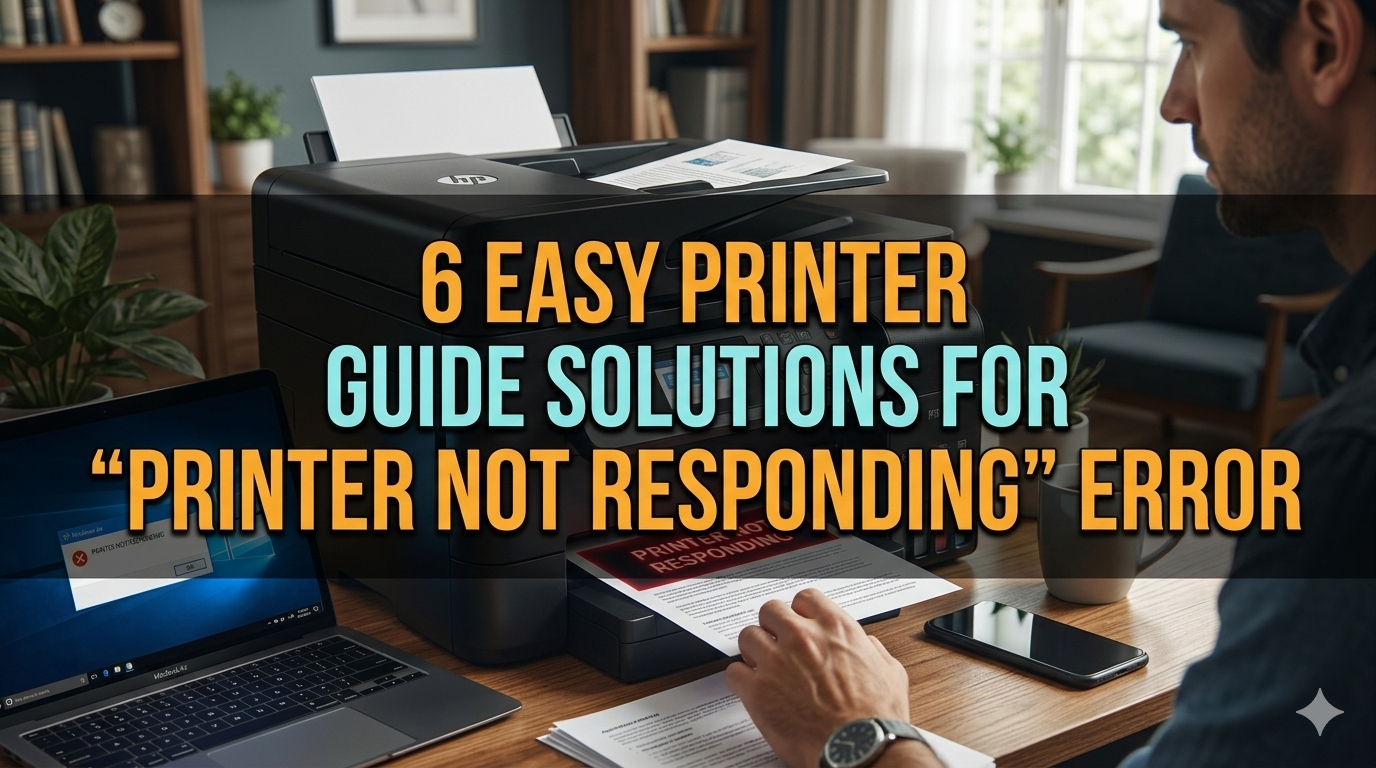
Meta Description: Printer Not Responding? Read on for 6 quick, step-by-step solutions to resolve this annoying error fast — no technology expertise required. Try fixing your printer with these steps today!
6 Easy Solutions to Fix Error “Printer Not Responding”
You hit print. Nothing happens. You hit print again. Still nothing. Sound familiar?
The “Printer Not Responding” error is among the most common — and in-demand to troubleshoot — tech problems people face, at home and at work. It appears at the most inconvenient moments: just before a deadline, during an important meeting, or when you simply need one document printed.
The good news? You do not have to be a tech expert to get it fixed.
This guide covers 6 solutions that are proven to work, and are easy to follow. Each remedy is described in simple language so anyone can follow — even if you’ve never touched a printer setting in your life.
Let’s get your printer back to life.
What Causes the “Printer Not Responding” Error?
Before diving into the fixes, it helps to know why this error appears in the first place.
Your printer and computer must be able to communicate. When that communication fails — for whatever reason — your printer simply sits there doing nothing. It’s not broken. It’s confused.
Here are the top reasons it happens:
| Cause | How Common? |
|---|---|
| Loose or faulty cable connection | Very Common |
| Outdated or corrupted printer driver | Very Common |
| Print queue stuck with old jobs | Common |
| Printer set to “Offline” mode | Common |
| Firewall or antivirus blocking the printer | Less Common |
| Printer service turned off in Windows | Less Common |
Now that you know what it is, let’s fix it.
Solution 1: First Look at These Basics — Cables, Power, and Connection
This might sound too simple. But trust the process.
About 30 percent of “Printer Not Responding” incidents are the result of something physical — a loose cable, a switch that got turned off, or a Wi-Fi connection that dropped without anyone noticing.
Start With the Physical Stuff
- Ensure that the printer is plugged in and turned on. Make sure that the power light is on.
- If you’re relying on a USB cable, detach it at both ends and reconnect it securely.
- Use a different USB port on the computer. Sometimes ports go bad.
- If you’re trying a different USB cable, even better — sometimes cables just fail without indicating so.
Make Sure Your Printer Is Connected to Wi-Fi (For Wireless Printers)
Wireless printers drop their connections more often than people think.
- Ensure your printer is connected to the same Wi-Fi network as your computer.
- Power cycle your Wi-Fi router by unplugging it for 30 seconds and plugging it back in.
- Find the Wi-Fi or Network Settings option on your printer’s screen or control panel, and connect it to your network again.
Restart Everything
This is the classic move — and it succeeds more than you’d expect.
- Turn off your printer completely.
- Shut down your computer.
- Wait 60 seconds.
- First, turn the printer back on.
- Then turn on your computer.
After booting both devices completely, try to print again.
Solution 2: Set Your Printer as the Default Printer
Here’s something the vast majority of folks don’t consider: your computer could be attempting to print to the wrong printer.
If you have ever plugged in multiple printers — or installed a virtual PDF printer, for that matter — Windows may be redirecting your print jobs elsewhere entirely. Which is why your actual printer sits unused.
How to Change the Default Printer in Windows
- Open the Start Menu and navigate to Settings.
- Click Bluetooth & Devices, and click Printers & Scanners.
- Select your printer from the list.
- Click it and choose Set as Default.
There’s also a sneaky setting that can trip us up. Windows has an option called “Let Windows manage my default printer.” When this is enabled, Windows will automatically update your default printer after you use it last. Turning it off allows you to be in charge.
To turn it off:
- Open Printers & Scanners settings.
- Scroll down and turn off the option that says “Let Windows manage my default printer.”
How to Change the Default Printer on Mac
- Open System Settings (or System Preferences on older Macs).
- Click Printers & Scanners.
- Locate and select your printer.
- Scroll to the bottom, find Default Printer, and select your printer from the dropdown.
Now try printing again. This small change resolves the “Printer Not Responding” error for many users.
Solution 3: Clear the Print Queue — The Silent Jam
Consider the print queue as the line at a café. When an order gets stuck at the front, all others are never served.
Your printer has a queue — a list of documents waiting in line to be printed. An old print job that didn’t succeed can, at times, get stuck in that queue and block all other jobs. Your printer does not respond because it’s still busy handling that stuck job.
How to Clear the Print Queue on Windows
Method 1: Through Settings
- Open Settings > Bluetooth & Devices > Printers & Scanners.
- Click on your printer.
- Select Open Print Queue.
- Right-click on each document and select Cancel.
Method 2: Through Services (More Reliable)
The regular way doesn’t always work. Here’s a deeper fix:
- Press Windows Key + R to open the Run box.
- Type
services.mscand press Enter. - Scroll down the list to find Print Spooler.
- Right-click it and choose Stop.
- Open File Explorer and navigate to:
C:\Windows\System32\spool\PRINTERS - Remove all the files in that folder. (Without deleting the folder itself — only the files inside.)
- Return to Services, locate Print Spooler again and click Start.
This will completely wipe the print queue and give your printer a fresh start.
How to Clear the Print Queue on Mac
- Go to System Settings > Printers & Scanners.
- Click on your printer.
- Click Open Print Queue.
- Next to every stuck job, click the X to cancel it.
Solution 4: Update or Reinstall the Printer Driver
If none of the first three fixes worked and your printer still is not responding, the culprit is likely your printer driver.
A driver is a tiny bit of software that allows your computer and printer to communicate with one another. If that driver is old, corrupted, or missing, your printer won’t respond — no matter what you do.
What Are Printer Drivers? (Simple Explanation)
Think of it this way — your computer speaks English and your printer speaks Spanish. The driver is the translator between them. If the translator falls ill or vanishes, there is no communication at all.
How to Update Your Printer Driver on Windows
Option 1: Through Device Manager
- Right-click on the Start Menu and select Device Manager.
- Expand the Printers section.
- Right-click your printer and select Update Driver.
- Select Search Automatically for Drivers.
- Windows will search for and install the newest version.
Option 2: From the Manufacturer’s Website
This method is more reliable. Visit the official site for your specific printer brand:
| Printer Brand | Driver Download Page |
|---|---|
| HP | support.hp.com |
| Canon | usa.canon.com/support |
| Epson | epson.com/support |
| Brother | support.brother.com |
| Lexmark | lexmark.com/support |
Look up your specific printer model and download the most recent driver for your operating system.
How to Reinstall the Driver (If Updating Doesn’t Work)
Sometimes updating isn’t enough. You need to uninstall the old driver completely and install a new one.
- Go to Device Manager.
- Right-click your printer and select Uninstall Device.
- Tick the option “Delete the driver software for this device.”
- Click Uninstall.
- Restart your computer.
- Download and install a fresh driver from the manufacturer’s website.
After reinstalling, print a test page. This should fix the “Printer Not Responding” error most of the time.
For more detailed printer troubleshooting guides and step-by-step fixes, visit Printer Troubleshoot Guide — a helpful resource for resolving all kinds of printer errors.
Solution 5: Check the Printer Status — Is It Offline?
There is an odd behavior in Windows where it sometimes marks a printer as Offline even when the printer is fully powered on and ready to go. When a printer is set to offline mode, it ignores every single print job you send.
This is most commonly a problem with wireless printers — especially after either a Wi-Fi interruption or a Windows update.
How to Check and Change the Status of Your Printer
- Go to Settings > Bluetooth & Devices > Printers & Scanners.
- Click on your printer.
- Check the status listed under the printer name.
- If it says Offline, you have some work to do.
How to Get It Back Online:
- Click Open Print Queue.
- Click the Printer menu at the top of the Print Queue window.
- If you find a checkmark next to Use Printer Offline, click it to uncheck it.
- Your printer should return to Online status right away.
If the printer continues to go offline on its own, here’s a more permanent solution:
- Open Control Panel > Devices and Printers.
- Right-click on your printer and select Printer Properties.
- Click on the Ports tab and ensure the correct port is selected (most likely a USB port or a network IP address).
For Mac Users
- Open System Settings > Printers & Scanners.
- If you see a yellow or red light next to your printer, something is wrong.
- If the printer appears as paused, click the printer and select Resume.
- You can also try removing the printer and re-adding it fresh.
Solution 6: Restart the Print Spooler Service
The Print Spooler is a Windows service that runs in the background and handles all print jobs on your computer. Consider it the traffic controller for all things headed toward your printer.
Once this service crashes or stops — which happens more often than you’d think — your printer will instantly stop responding. No error message. No warning. It just goes silent.
According to Microsoft’s official support documentation, restarting the Print Spooler service is one of the first recommended steps when dealing with printer connectivity issues.
How to Restart the Print Spooler on Windows
- Press Windows Key + R to open the Run dialog.
- Type
services.mscand press Enter. - You will see a list of services. Scroll down to locate Print Spooler.
- Check the Status column next to it. If it says “Stopped,” that’s your problem.
- Right-click Print Spooler and select Restart.
- Wait a few seconds, then try printing again.
Set the Print Spooler to Start Automatically
To avoid this issue occurring in the future:
- In the Services window, double-click Print Spooler.
- Find the Startup type dropdown.
- Change it to Automatic.
- Click Apply, then OK.
Now, whenever you boot your computer, the Print Spooler will start automatically — so you won’t face this problem again.
Quick Reference: Which Fix to Try First?
Not sure where to start? Use this simple guide:
| Your Situation | Try This Solution First |
|---|---|
| Printer not responding at all | Solution 1 (Check Cables & Power) |
| Print job disappears but nothing prints | Solution 3 (Clear Print Queue) |
| Printer appears offline | Solution 5 (Fix Printer Status) |
| Printing worked before but not anymore | Solution 4 (Update/Reinstall Driver) |
| Printer worked fine previously but stopped suddenly | Solution 6 (Restart Print Spooler) |
| Multiple printers installed | Solution 2 (Set Default Printer) |
Extra Tips to Prevent “Printer Not Responding” in the Future
Fixing the problem is great. Stopping it from happening again is even better.
Here are some habits that will save you a lot of headaches:
- Keep your drivers updated. Check for driver updates every few months, particularly after major Windows or Mac updates.
- Don’t let print jobs pile up. Cancel a job that has failed — do not send the same document 10 more times.
- Reboot your printer once a week. Power cycling helps maintain the printer’s internal memory.
- When available, use a wired connection. It is more reliable to print using a USB connection rather than Wi-Fi.
- Don’t ignore firmware updates. Printers also have their own internal software called firmware, which needs updates as well. Check the manufacturer’s website occasionally.
FAQs: “Printer Not Responding” — Your Questions Answered
Q1: My printer is on, so why does it say “Not Responding”?
Having your printer on does not mean that you are properly connected. We are likely looking at either a stuck print queue, the printer being offline, or a corrupted printer driver. Begin with Solution 5 (Check the Status of Your Printer) and then Solution 3 (Clear Print Queue).
Q2: Is there a solution for “Printer Not Responding” on Windows 11?
Definitely. Windows 11 sometimes tweaks printer setups after updates. Head to Settings > Bluetooth & Devices > Printers & Scanners, confirm your printer is the default, and ensure it’s not set to offline. Next, use Solution 6 to restart the Print Spooler service.
Q3: My printer worked yesterday. What is wrong with it today?
That’s often due to one of three things: a Windows update that altered driver settings, a problem reconnecting to Wi-Fi, or the Print Spooler service stopping on its own. First try Solution 1, then Solution 3.
Q4: Can a virus or antivirus software cause “Printer Not Responding”?
Yes, it can. Some antivirus programs block printer communication as a precaution. Temporarily turn off your antivirus and try printing again. If it works, make sure to add your printer as an exclusion in your antivirus settings.
Q5: How do I fix “Printer Not Responding” without reinstalling the driver?
Work through clearing the print queue (Solution 3), restarting the Print Spooler (Solution 6), and checking the printer status (Solution 5). In most cases, you can fix the error without ever touching any drivers.
Q6: Does this affect wireless printers as well?
Absolutely. All six solutions in this guide work for both wired (USB) and wireless printers. If you are using a wireless printer, pay extra attention to Solution 1 (Wi-Fi connection check) and Solution 5 (Offline status fix), as these are the most common causes for network printers.
Q7: What can I do if none of these solutions work?
If all six solutions fail, it’s possible the problem is hardware-related — a malfunctioning print head, damaged circuit board, or a worn-out USB port on the printer itself. From there, you will want to reach out to the manufacturer’s support team or take the printer to a repair shop.
Wrapping It All Up
The “Printer Not Responding” error is annoying — but it’s almost always solvable.
In the majority of situations, one of these six solutions will fix it in under 10 minutes:
- Inspect cables, power, and Wi-Fi connection
- Make your printer the default
- Clear the stuck print queue
- Update or reinstall the printer driver
- Fix the offline printer status
- Restart the Print Spooler service
Start from the top and work your way down. You don’t require any special technical expertise. Simply stick to the steps as they appear and your printer will be in good shape again before you know it.
And after you’ve fixed it, follow the prevention tips in this guide so that next week, you aren’t stuck again at the same error.
Good luck — and happy printing!