
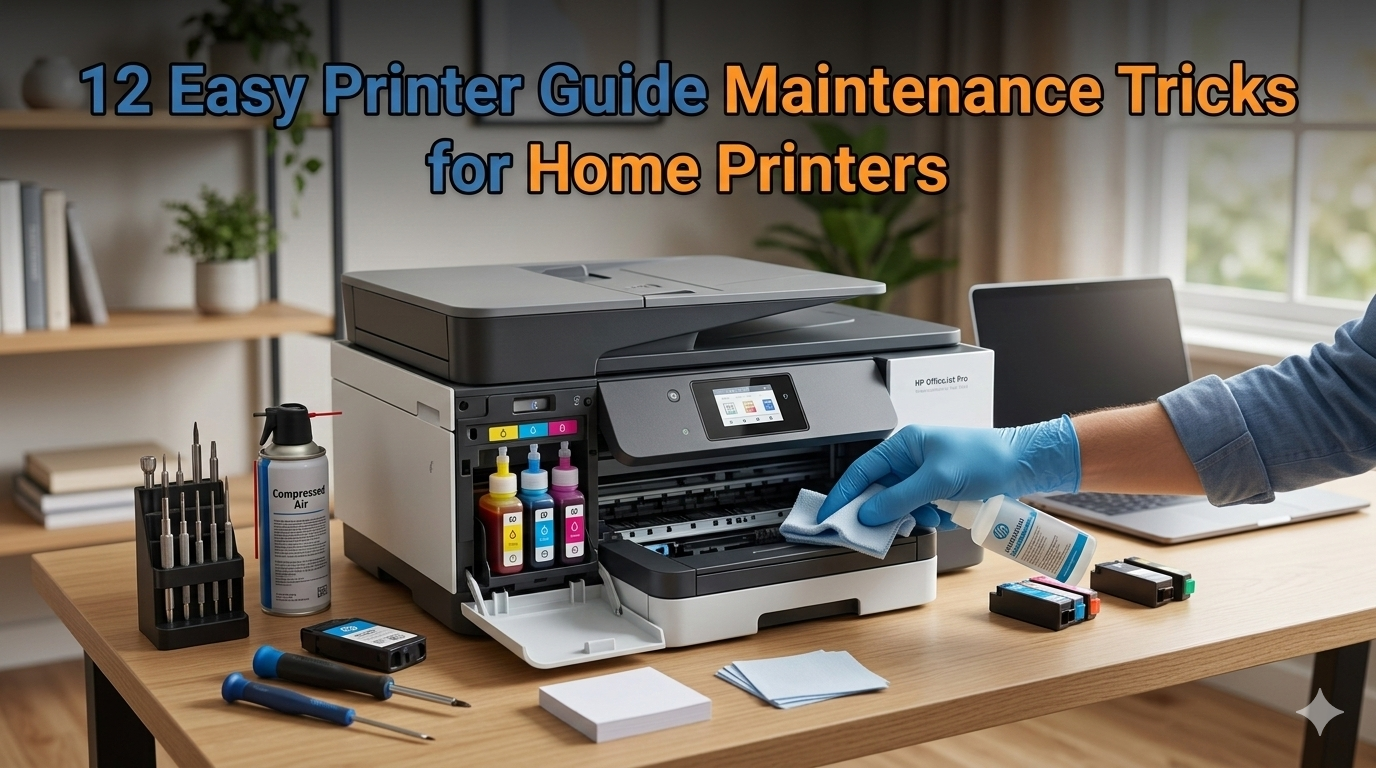
12 Simple Tips To Keep Your Home Printers Maintained
Meta Description: Printer guide maintenance is not difficult. 12 Home Printer Care Tips to Prevent Problems Before They Start
The Life Your Home Printer Deserves (and Is Not Getting)
Let’s be honest. Most people pay no attention to their printer until there’s a problem.
Then comes the panic. Streaky pages. Paper jams. Ink smears. A printer that just won’t cooperate when you need it most.
The good news? Many of these problems are wholly preventable.
Printer guide maintenance is the process of cleaning, inspecting, and maintaining your printer so that it will continue to perform at its best. It sounds techy, but it’s really easy when you know how.
This guide outlines 12 simple, novice-friendly tricks you can implement today. Whether you own an inkjet, laser, or all-in-one printer, these tricks will yield cleaner prints, fewer jams, and a longer-running machine.
No technical background needed. Let’s get into it.
Why Printer Maintenance Actually Matters
Before diving into the tricks, here’s why this stuff is worth your time.
A badly cared for printer does not only print poorly. It can also:
- Waste expensive ink or toner
- Cause frequent paper jams
- Make smudges and marks on pending documents
- Break down faster than it should
- Cost you more money in repairs or replacements
A well-maintained home printer can live 5 to 10 years, according to industry estimates. A neglected one? Sometimes less than two.
Just 10 minutes a month of basic printer guide maintenance can keep you from spending hundreds down the road.
Tip #1 — Regularly Clean Paper Feed Rollers
The paper feed rollers are the small rubber wheels in your printer that take hold of a piece of paper and pull it through.
They accumulate dust and dried paper fibers over the years. At that point, the rollers cannot hold on. And that’s what produces most paper jams and misfeeds.
How to clean them:
- Switch your printer off and unplug it
- Remove all paper from the paper tray
- Moisten a lint-free cloth with distilled water (not tap water)
- Use a gentle, rotating motion to clean each roller
- Allow everything to dry completely before reloading paper
Do this every 2 to 3 months. It’s one of the best and most overlooked steps for printer guide maintenance.
Trick #2 — Run the Built-In Print Head Cleaning Tool
Most inkjet printers have a built-in cleaning function. Most people don’t even know it’s there.
This flushes the print heads with a bit of ink to clear any nozzles that have dried or clogged. It’s particularly helpful if you see faded colors or missing lines in your prints.
How to access it:
- On Windows: Control Panel → Devices and Printers → Right-click your printer → Printer Properties → Maintenance tab
- On Mac: System Settings → Printers & Scanners → Select your printer → Options & Supplies → Utility
Run this once a month, or whenever print quality drops. Just don’t go overboard — running it too many times wastes ink.
Tip #3 — Position the Printer to Optimize Performance
The location of your printer matters more than you might think.
Here’s what to avoid:
| Bad Location | Why It’s a Problem |
|---|---|
| Near a window | Sunlight dries out ink cartridges faster |
| Near a vent or heater | Heat warps paper and affects ink |
| Dusty area | Dust clogs internal components |
| Humid bathroom or kitchen | Moisture causes paper to jam and stick |
| On the floor | Collects more dust and gets kicked accidentally |
The best place is a clean, dry surface at room temperature. Avoid leaving the device in direct light and near air vents.
This simple placement trick requires no extra effort on your part to support long-term printer guide maintenance.
Trick #4 — Always Use the Right Paper
Not all paper is created equal.
One of the leading causes of paper jams, smearing, or even print head damage is the wrong-sized or low-quality paper.
Here’s what to look for:
- Use paper recommended for your printer weight (anywhere from 20–24 lb for most home printers)
- Don’t use crinkled, creased, or wet paper
- Fan the paper before putting it into the feeder to help sheets separate
- Never overfill the paper tray — keep at or below the maximum fill line
Also, keep your paper in a sealed plastic bag or airtight container. Paper absorbs moisture from the air and begins to warp, which eventually causes jams inside the printer.
Trick #5 — Wipe Down the Outside (Seriously, It Matters)
External dust eventually makes its way inside the printer.
Once dust gets inside the internal parts, it can block sensors, clog rollers, and disrupt paper movement.
Quick exterior cleaning routine:
- Shut off the printer and disconnect it from power
- Wipe the outside with a soft, dry microfiber cloth
- Blow out dirt with a can of compressed air
- Also wipe the paper tray and output tray
- Never use strong chemicals or wet rags directly on the printer
Do this once every two weeks. It takes about five minutes and helps keep the insides of your machine much cleaner in the long run.
Trick #6 — Prevent Your Printer from Sitting Idle Too Long
This one catches a lot of folks off guard.
Printers need to get used from time to time. Letting an inkjet printer sit idle for weeks to months causes the ink inside print heads to dry, causing clogs.
The solution is simple: Print at least one test page a week, even if you have no real need to print anything. A black-and-white text page does the job just as well.
This ensures that ink is constantly moving through the heads and prevents clogs from developing.
If you know you won’t be using the printer for a while, consult your manual — some models recommend removing cartridges and storing them in an airtight bag so they don’t dry out.
Trick #7 — Use Ink Cartridges Properly
Ink cartridges are fragile. Improper handling leads to leaks, clogs, and poor print quality.
How to Handle a Cartridge — Dos and Don’ts:
| Do This ✅ | Avoid This ❌ |
|---|---|
| Store unused in a cool, dark place | Don’t leave cartridges exposed to airflow for long periods of time |
| Install cartridges as soon as they are opened | Don’t shake before installing |
| Keep the protective tape on until ready to be used | Don’t touch copper contacts or nozzles |
| Replace when low, not bone dry | Don’t allow cartridges to run completely empty |
Using cartridges until they are completely empty can damage the print head. It’s best to change them when your printer tells you it’s low on ink.
Tip #8 — Keep Your Printer Drivers and Firmware Up to Date
This one lives in the digital world, not the physical one. But it’s just as important.
Printer manufacturers often publish driver updates and firmware patches that fix bugs, improve print quality, or increase compatibility with newer computers.
Using outdated drivers can cause:
- Slow printing
- Print jobs stuck in the queue
- Poor color accuracy
- Communication errors between the computer and printer
How to update:
- Go to your printer brand’s official website (HP, Canon, Epson, Brother, etc.)
- Search for your exact printer model
- Download and install the latest driver and firmware
- Restart your computer and printer afterward
Look for updates every three to six months. It’s one small step that keeps everything flowing.
Trick #9 — Wipe the Scanner Glass (If Your Printer Has One)
If you have an all-in-one printer with a scanner, the glass plate requires regular cleaning as well.
A dirty scanner glass causes:
- Streaks on scanned documents
- Shadow marks on copies
- Blurry or faded scan results
Cleaning steps:
- Open the scanner lid
- Apply a few drops of glass cleaner onto a soft cloth (never directly onto the glass)
- Wipe gently in a circular motion on the glass
- Wipe dry with a clean, lint-free cloth
- If the underside of the scanner lid looks dirty too, wipe it as well
Do this once a month if you do a lot of scanning, or every two to three months if you rarely use the scanner.
Trick #10 — Clear a Paper Jam the Right Way
Paper jams happen to everyone. But the way you clear them makes a world of difference.
Jerking paper out quickly and carelessly can tear it within the machine, damage rollers, and even bend internal parts.
The right way to clear a jam:
- Turn off the printer immediately
- Open all accessible panels (front, back, and sides)
- Locate the jammed paper
- Gently and slowly pull the paper in the direction it was moving
- Look for any torn bits that might remain inside — even tiny scraps create new jams
- Close all panels, power up the printer, and print a test page
Never force anything. If the paper won’t come out, consult the manual or reach out to support instead of risking damage to the machine.
Tip #11 — Calibrate Your Printer for Better Print Results
Calibration adjusts the position of the print heads so that text and images come out sharp and in the right place.
You should calibrate your printer if you experience any of these issues:
- Text that looks slightly blurry
- Color that doesn’t match what’s on your screen
- Lines that don’t align properly
Most printers allow you to calibrate from the control panel or through the printer software on your computer.
Basic calibration steps:
- Launch your printer software or application
- Go to Maintenance or Tools and look for “Alignment” or “Calibration”
- Follow the on-screen instructions (often involves printing an alignment sheet)
- Choose the best-looking pattern from the sheet
- Confirm and save the settings
Whenever you install a new cartridge or notice problems with print quality, calibrate your printer. It makes a surprisingly large difference.
If you run into recurring issues even after calibrating, Printer Troubleshoot Guide is a great resource for step-by-step fixes for all common home printer problems.
Tip #12 — Keep a Simple Maintenance Log
This final trick is the one most people skip — and absolutely should not.
A maintenance log is just a basic record of when you last cleaned, updated, or serviced your printer. It keeps you on schedule and lets you identify patterns before they escalate into bigger issues.
You don’t need anything fancy. A sticky note on the side of your printer or a note on your phone will do just fine.
What to log:
- Date of last roller cleaning
- Date when the print head was last cleaned
- Last firmware/driver update
- Last cartridge replacement
- Any error codes or problems noticed
When it’s written down, you’re never guessing. You always know what’s been done and what needs attention next.
Printer Maintenance Schedule at a Glance
Here’s a simple timetable you can follow to stay on top of your printer guide maintenance routine:
| Task | Frequency |
|---|---|
| Print a test page | Weekly |
| Wipe down exterior | Every 2 weeks |
| Clean scanner glass | Monthly |
| Run print head cleaning | Monthly |
| Clean paper feed rollers | Every 2–3 months |
| Check & update drivers/firmware | Every 3–6 months |
| Full internal dust cleaning | Every 6 months |
| Check and replace cartridges | As needed |
Post this schedule somewhere you’ll actually see it. On your printer, your fridge, or at your desk.
Signs Your Printer Needs Immediate Attention
Sometimes your printer will warn you of a problem before it fully breaks. Here are the warning signs to look for:
Print Quality Issues:
- Faded or streaky text
- Missing colors or lines
- Smearing that doesn’t dry properly
Mechanical Issues:
- Paper jams more than once a week
- Strange grinding or clicking sounds
- Paper not feeding properly
Software Issues:
- Print jobs stuck in queue
- Printer appears offline when it is switched on
- Error messages appearing repeatedly
If you notice any of these signs, address them immediately. The majority of the tricks in this guide will resolve these issues before they grow.
According to Consumer Reports’ printer reliability guide, regular maintenance is one of the top factors that determines how long a home printer lasts — making these habits well worth building early.
FAQs About Printer Guide Maintenance
Q: With what frequency should I clean my home printer? A: A light wipe on the outside every two weeks and a more thorough cleaning (rollers, print heads) once per month is a good routine for most home printers.
Q: Can I use regular tap water to clean printer components? A: No. Always use distilled water. Tap water contains minerals that can leave deposits on sensitive parts such as rollers and print heads.
Q: What will happen if I never clean my printer? A: Dust and dried ink accumulate over time, causing poor print quality, repeated paper jams, and eventually hardware damage that can necessitate costly repairs or complete replacement.
Q: My printer is just printing blank pages. What does that mean? A: This generally indicates a clogged print head or an empty cartridge. First, run the built-in head-cleaning tool. If it continues printing blank, check your ink levels.
Q: Are third-party ink cartridges safe to use? A: They can be effective, although quality is not consistent. Third-party cartridges of poor quality might clog print heads or leak. If you do use them, choose reputable brands and keep a close eye on print quality.
Q: How can I tell if my printer drivers are out of date? A: Head to your printer maker’s website and compare the version number available for download with the version currently installed on your computer. If they don’t match, update.
Q: Do I need to turn off my printer when I’m not using it? A: Yes, unless you print several times a day. Leaving it on all the time wastes energy and risks overheating components over time. But do not leave it entirely unplugged for long periods, as that can dry out the ink.
Q: Will humidity affect my printer? A: Absolutely. Paper absorbs moisture in high humidity, which can cause jams and smearing. Store your printer in a room with regular humidity levels, away from kitchens and bathrooms.
A Little Care Goes a Long Way
Here’s the bottom line.
Your home printer is a workhorse, whether you use it for school projects, work documents, photos, or everything in between. A little conscientiousness goes a long way in determining how well and how long it performs.
Printer guide maintenance doesn’t require tech guru skills. It’s a handful of basic habits. Clean the rollers. Run the print head tool. Use the right paper. Keep it dusted. Print a test page every week.
That’s it. Do those things regularly, and your printer will reward you with smooth, clean, reliable prints for years to come.
Select one or two of these tricks and get after it today. When those feel good, add a few more. Soon you’ll be doing a full maintenance routine that takes nearly zero time but makes a huge impact.
Your future self — the one who never has to contend with a jammed printer just before a deadline — will appreciate it.