
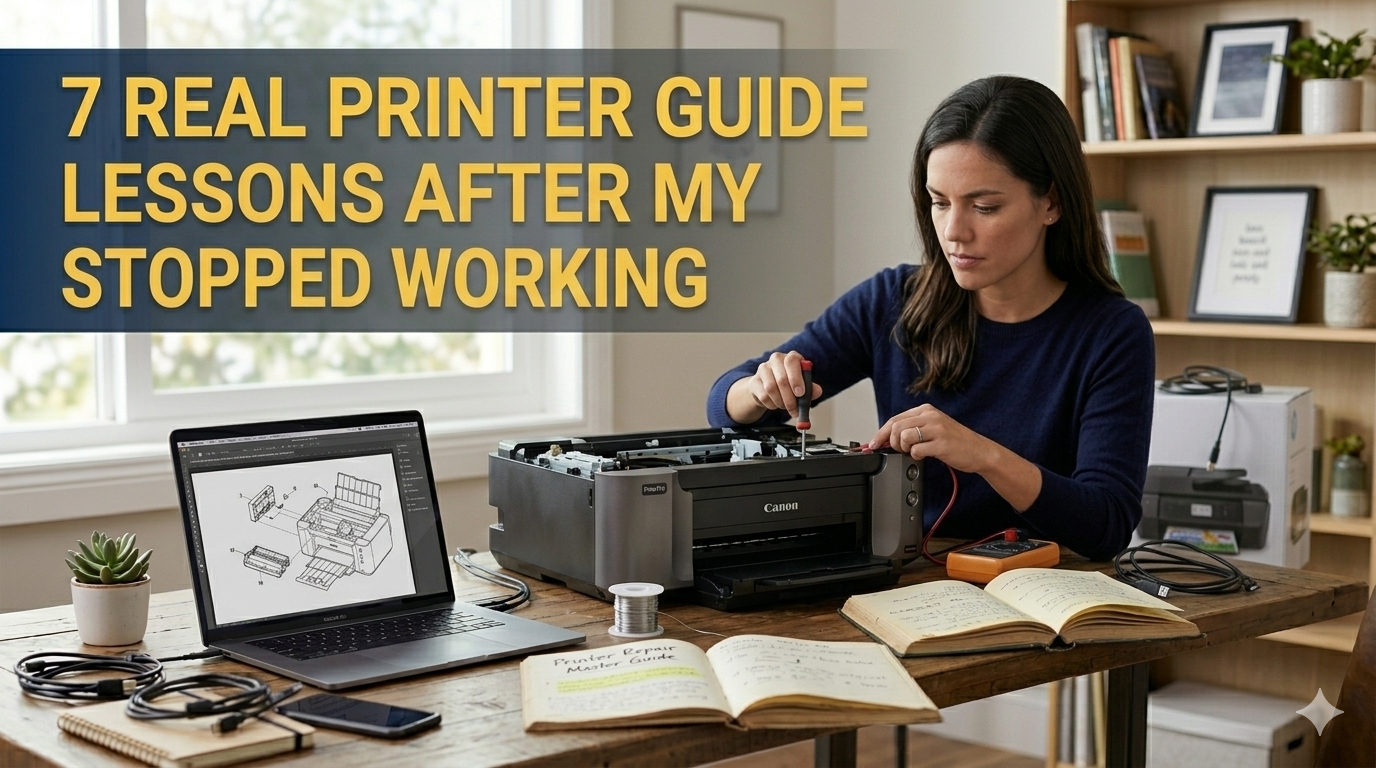
7 Real Lessons About Printers From When My Printer Wouldn’t Work
Meta Description: Printer stopped working? 7 actual printer helper lessons learned the hard way — implementation fixes, maintenance advice and when to call in a technician.
Nothing can be more agonizing than pressing “print” and hearing crickets.
No whirring. No paper moving. Just a blinking light and a screen with error messages you’ve never seen before.
That is precisely what I experienced. My printer — which had worked fine for three years — suddenly decided to die. What ensued was hours of troubleshooting, several moments of panic and, ultimately, a remedial lesson in how printers really work.
This article shares those lessons. Each and every one was gifted from real experience — not a manual. Whether your printer is misbehaving at the moment or you want to be prepared in case it does, these 7 lessons will save you time, money and a lot of stress.
Lesson 1: The Issue Is Almost Never What You Think It Is
My printer stopped working, so my first thought was: “It’s broken. I need a new one.”
That was wrong.
Most printer issues can be attributed to the little things — a setting that was turned off, a cable that became loose, or a driver that needs updating. That which is showing the symptom is almost never the actual source of the cause.
Stop and Diagnose Before Doing Anything Else
The most common error people make is going straight to fixes without understanding the problem.
Before touching anything, ask yourself:
- Did the printer work yesterday?
- Was anything changed recently (new computer, new update, new WiFi)?
- Is there an error message showing anywhere?
- Are there any lights blinking on the printer itself?
These questions help focus quickly on the cause. A printer that worked yesterday and doesn’t work today presents a very different problem than one that was never set up properly to begin with.
What the Error Lights Really Mean
Most printers communicate error states by blinking lights. One blink usually indicates a paper jam. Quicker blinking usually indicates an ink problem. A steady orange or red light usually indicates a hardware issue.
Look up your printer’s manual (or search the model number + “error light meaning”) to decode what the exact pattern means. This one simple step can save you 30 minutes of random troubleshooting.
Lesson 2: Paper Jams Are Sneaky — And They Leave Bits Behind
I was under the impression that I had cleared my paper jam. I took out the crumpled sheet, reloaded the tray and hit print.
The printer jammed again immediately.
Here’s what I didn’t know: paper jams can leave behind tiny torn pieces of paper inside the machine. These scraps lurk in rollers, behind trays and close to the ink heads. The printer treats them like any other jam and won’t budge.
How to Correctly Remove a Paper Jam
| Step | What to Do |
|---|---|
| 1 | Power the printer down completely |
| 2 | Open every door and tray panel |
| 3 | Search for paper with a flashlight |
| 4 | Gently pull paper in the direction it was feeding |
| 5 | Check for torn bits — be thorough |
| 6 | Close everything and restart |
The key rule: don’t pull the paper out fast. Always pull slowly and steadily in the direction of travel. Yanking causes tearing, which leaves the hidden bits that cause the next jam.
Preventing Future Jams
Jams happen most often for three reasons:
Wrong paper type. If your printer is made for 20lb paper and you’re feeding it thick cardstock, jams are nearly a certainty.
Overfilled tray. Each printer tray has a maximum fill line. Going past it causes misfeeds.
Old or damp paper. Paper that has taken in moisture from the air does not feed cleanly. Keep your paper in a dry area with the packaging sealed.
Lesson 3: Ink Cartridges Are Liars (And Dried-Up Ink Is a Real Thing)
My printer informed me it was low on ink. I replaced the cartridge. The printer still didn’t print right.
The pages came out faded and streaky, even with fresh ink.
The culprit turned out to be dried ink on the print head — the part of a printer that sprays ink onto paper. When a printer does not get used for weeks or months, ink dries up on the nozzles and clogs them. If the head is clogged, a new cartridge won’t solve it.
Performing a Print Head Cleaning Cycle
Almost all printers come with a built-in cleaning function. Here is how to find it:
- On Windows: Devices and Printers → right-click your printer → Printing Preferences → Maintenance tab
- On Mac: System Settings → Printers & Scanners → click on your printer → Options & Supplies → Utility
- On the printer itself: Many printers have a maintenance button or menu in the settings screen
Perform one cleaning cycle, then print a test page. If your output is still streaky, run another cycle. Don’t run them more than three in a row — cleaning cycles drain ink, and too many will waste cartridges.
The Truth About Third-Party Ink
Third-party or refilled cartridges are less expensive. But they come with risks.
| Factor | OEM Cartridges | Third-Party Cartridges |
|---|---|---|
| Price | More expensive | Less expensive |
| Print quality | Consistent | Variable by brand & model |
| Clog & leakage risk | Low | High |
| Warranty impact | None | May void warranty |
| Chip compatibility | Always fits | Sometimes fails |
If you’re going to use third-party ink, go with a reputable brand and check reviews for your specific printer model. Cheap, off-brand cartridges are the biggest cause of clogged print heads.
Lesson 4: Drivers and Software Cause More Mistakes Than Hardware
Once the ink issue was resolved, my printer connected to my laptop but did not print anything. Jobs went to the queue and just… sat there.
This is a driver problem. And it is extremely common.
The printer driver is the software that allows your computer to communicate with your printer. When this software becomes corrupted, goes outdated, or conflicts with a system update, the printer shows as connected yet won’t work.
For a deeper look at common printer errors and how to fix them, Printer Troubleshoot Guide is a solid resource worth bookmarking.
How to Fix a Stuck Print Queue
A stuck print queue is one of the most common printer problems on Windows. Here is a quick fix:
- Open Start and search for “Services”
- Scroll down to “Print Spooler” and right-click it
- Click “Stop”
- Open File Explorer and navigate to:
C:\Windows\System32\spool\PRINTERS - Delete all files inside (do not delete the folder itself)
- Go back to Services and click “Start” on Print Spooler
- Try printing again
This removes the stuck jobs and restarts the printing system. It works about 80% of the time.
Updating or Reinstalling Printer Drivers
If that does not fix things, the driver itself may be at fault.
Visit your printer manufacturer’s website (HP, Canon, Epson, Brother, etc.) and type in your model number. Download and clean install the latest driver for your operating system. Always uninstall the old driver first through your computer’s Settings or Control Panel.
On Mac, printer drivers usually update automatically through System Updates. If your printer broke after a macOS update, look for an updated driver on the manufacturer’s site.
Lesson 5: WiFi Printers Have a Different Set of Rules
My printer is wireless. When it stopped working, the issue was not with the printer at all.
It was the network.
WiFi printers are convenient, but they’re also one more device that relies on a stable network connection. The printer disappears from the network when the router restarts, when the IP address changes, or when the signal gets weak.
Why Your Wireless Printer Keeps Dropping Connection
Here are the most common reasons:
Dynamic IP addresses. Most home routers give devices a new IP address when they reconnect. Your computer may be sending print jobs to the old IP address where the printer used to live.
2.4GHz vs 5GHz bands. Most modern routers broadcast two separate networks. Printers generally connect to the 2.4GHz band. If your computer is on the 5GHz band and your printer is on 2.4GHz, they are effectively on different networks and cannot communicate properly.
Router distance. A printer in a back room with poor WiFi coverage will frequently disconnect. Concrete and brick walls reduce signal strength greatly.
How to Set a Static IP for Your Printer
This one adjustment made my wireless printer reliable for the first time.
A static IP address means your printer always receives the same address on your network. Your computer always knows exactly where to find it.
To set this up:
- Find the current IP address for your printer (shown in the printer’s network settings menu)
- Log into your router admin page (usually
192.168.1.1or192.168.0.1) - Look for “DHCP Reservation” or “Static IP” settings
- Assign a fixed IP to your printer’s MAC address
Once you have done this, your printer should stay connected consistently.
Lesson 6: A Little Maintenance Goes a Long Way
Prior to my printer failing, I had never once cleaned it or done any maintenance. I just used it and figured it would keep working.
That was a mistake.
Printers need maintenance just like cars. Dust builds up inside. Rollers get dirty. Ink residue accumulates near the print head. All of this leads to a slow performance decline — until one day, it simply stops.
A Simple Printer Maintenance Checklist
Here is what you should do every 3–6 months:
External cleaning:
- Wipe the outside with a soft, dry cloth
- Clean the scanner glass (if your printer has one) with a glass cleaner and a lint-free cloth
- Get dust out of vents with a can of compressed air
Internal cleaning:
- Open the paper tray and wipe the rollers with a slightly damp cloth
- Look for paper scraps or debris inside
- Run the printer’s built-in cleaning utility
Software maintenance:
- Check for firmware updates on the manufacturer’s website
- Update your printer driver
- Clear out old print jobs from the queue
Ink management:
- Do not let cartridges run completely dry — replace them when the printer warns you
- If you do not print frequently, print at least one page per week to keep ink flowing and avoid clogs
How Often Should You Actually Print?
This is a question many people never consider. Inkjet printers, specifically, are made to be used frequently. When a printer sits idle for long periods, the ink inside the cartridges and print heads can dry up.
If you print less often, a laser printer may be more suitable. Laser printers use toner (a dry powder), not liquid ink, so they don’t suffer the same drying and clogging issues. According to Consumer Reports’ printer buying guide, laser printers tend to outperform inkjets for reliability when print volume is low. They cost more upfront but deliver greater reliability for low-volume printing.
Lesson 7: When to Call a Professional (And When Not To)
After all that troubleshooting, there was still one issue I couldn’t resolve myself: a grinding noise coming from deep inside the printer when it attempted to feed paper.
That was a mechanical failure — a worn roller or broken gear inside the machine. No software fix, no cleaning would solve it.
Knowing when a problem is beyond your DIY skills is just as important as knowing how to troubleshoot.
Problems You Can Fix Yourself
- Paper jams
- Clogged print heads
- Outdated or corrupted drivers
- WiFi connectivity issues
- Empty or low ink cartridges
- Stuck print queues
- Streaky or faded prints
Problems That Need Professional Help
- Grinding or clicking mechanical sounds
- Printer that smells like burning
- Ink pooling or spreading across the whole page (not just smearing)
- Physical damage to the feed rollers or paper path
- Error codes that do not clear after normal troubleshooting
Should You Repair or Replace?
Here is a useful framework to consider:
If the cost of repair is more than 50% of the cost of a new printer, buy a new printer.
If a $100 printer costs more than $50 to repair, it is not worth fixing. With a $400 multifunction printer, professional repair makes more sense.
Also consider age. A printer over 5 years old is nearing the end of a reliable lifespan. Spending money to fix an aging machine often just delays the inevitable.

Quick-Reference Summary: The 7 Lessons
| # | Lesson | Key Takeaway |
|---|---|---|
| 1 | Diagnose first, then repair | The actual cause is often not obvious |
| 2 | Clear jams completely | Check for torn paper remnants |
| 3 | Clean the print head | New ink does not fix clogged nozzles |
| 4 | Update your drivers | Software causes most connectivity problems |
| 5 | Fix your WiFi setup | Static IP solves many wireless problems |
| 6 | Maintain regularly | Regular care prevents serious breakdowns |
| 7 | Know your limits | Some repairs need a professional |
FAQs: Questions From a Real Printer Guide
Q: Why does my printer say it’s offline when it’s clearly on?
More often than not, this is a driver or network-related issue. Try turning the printer and your router off and back on again. On Windows, go to Devices and Printers, right-click your printer, and choose “See what’s printing.” Then select Printer in the menu bar and deselect “Use Printer Offline.”
Q: How do I tell if my print head is clogged or my cartridge is empty?
Print a test page from your printer’s maintenance menu. If the page comes out with missing colors or horizontal white lines through the print, the head is likely clogged. If some colors are totally absent, the cartridge may be out of ink. Most printers display ink levels in their software.
Q: My printer prints blank pages. What’s happening?
Blank pages generally mean one of three things: the ink cartridge is either empty or installed incorrectly, the print head is severely clogged, or you accidentally sent a blank document to print. Check your cartridge, run a cleaning cycle, and confirm the document has content before printing.
Q: Is it okay to leave a printer switched on constantly?
Yes, for most modern printers. When a printer sits idle, it performs small maintenance cycles to prevent ink from drying inside the nozzles, so leaving it on actually helps. Turning it off and on repeatedly may cause more wear on some models. That said, turning it off if you’re going to be away for more than a week is perfectly reasonable.
Q: Why does my printer use color ink even when I’m printing in black and white?
Many inkjet printers use a mixture of color inks to produce a deeper black. You can adjust this in your printer settings — look for “Black Ink Only” or “Grayscale” mode in the print dialog. This saves color ink significantly.
Q: If I don’t print very often, how long will ink cartridges last?
Ink cartridges expire, typically 1–2 years after manufacture. Even if you don’t use them, the ink inside can dry or degrade over time. Check the date stamped on the cartridge packaging. Stored in a cool, dark place, unused cartridges will keep longer.
Q: Can I use my printer without WiFi?
Yes. USB connection is compatible with most printers and works without any network at all. Just plug the printer into your computer with a USB cable, install the driver, and print directly. Some printers also support Bluetooth. WiFi is convenient, but not necessary.
Wrapping It All Up
When my printer went on the fritz, I felt powerless. Printers seem so mysterious — they either work or they don’t.
But they are not mysterious. They present predictable problems and logical solutions.
The 7 lessons in this real printer guide — diagnose carefully, clear jams thoroughly, clean print heads properly, update drivers when needed, fix WiFi settings, do regular maintenance, and know when to seek help — will get you through the overwhelming majority of everything that can go wrong.
No technician skills required. You just have to know where to look and what to do next.
Save this guide. The next time your printer acts up, you’ll know exactly how to handle it.