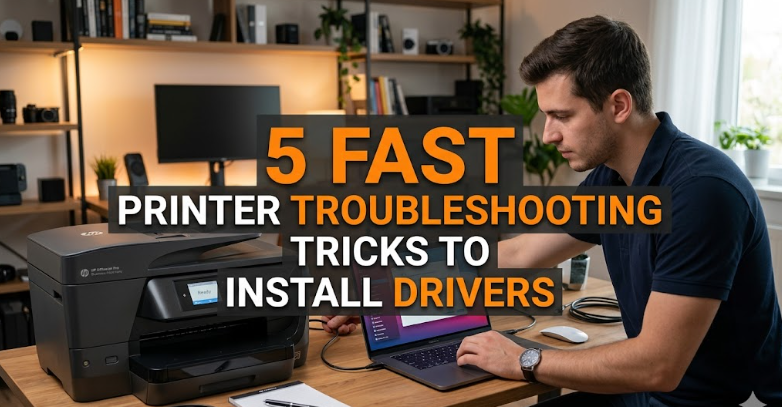
5 Fast Printer Troubleshooting Tricks to Install Drivers
Introduction
Installing printer drivers sounds simple in theory, but in real life it often turns into one of the most frustrating parts of setting up a printer. Whether you’re connecting a wireless printer at home, setting up a shared office device, or trying to fix an “unable to install driver” error, the process can quickly get stuck due to compatibility issues, missing files, outdated software, or even background system conflicts.
Printer drivers act as a communication bridge between your computer and the printer. Without the correct driver, your system cannot understand how to send print commands properly. That’s why even a perfectly working printer can appear “dead” if the driver installation fails.
The good news is that most driver installation issues are not complicated hardware problems. They are usually software glitches or configuration errors that can be fixed quickly if you follow the right steps.
This article walks through five fast troubleshooting tricks that help you install printer drivers without unnecessary stress. Each method is practical, tested in real-world scenarios, and suitable for Windows and Mac users.
By the end, you’ll also understand why driver issues happen and how to avoid them in the future.
Understanding Why Printer Driver Installation Fails
Before jumping into solutions, it helps to understand the common causes of driver installation failure:
- Incorrect driver version downloaded
- Operating system mismatch (Windows 10/11 vs older versions)
- Corrupted installation files
- Previous printer drivers causing conflicts
- Disabled system services required for installation
- Antivirus or firewall blocking installation
- Poor or unstable internet connection during setup
Once you identify the possible cause, fixing the issue becomes much faster.
Now let’s move to the actual troubleshooting tricks.
Trick 1: Remove Old or Conflicting Printer Drivers First
One of the biggest hidden problems in driver installation is leftover files from previous printers. Even if you think you removed an old printer, parts of its driver may still be active in the system.
Why this matters
When multiple printer drivers conflict, your system may:
- Install the wrong driver automatically
- Freeze during installation
- Show “driver unavailable” errors
- Fail to detect the printer completely
How to fix it
On Windows:
- Open Control Panel
- Go to Devices and Printers
- Remove all existing printer entries
- Open Print Server Properties
- Under the Drivers tab, remove old printer drivers
- Restart your computer
On Mac:
- Open System Settings
- Go to Printers & Scanners
- Remove all listed printers
- Reset printing system if needed
- Restart Mac
Once cleaned, try installing the new driver again.
This single step resolves more installation issues than any other fix.
Trick 2: Download Drivers Directly from the Official Source
A surprising number of installation problems come from downloading the wrong driver.
Many users rely on:
- Third-party driver websites
- Automatic system updates
- Old installation CDs
These sources often provide outdated or incompatible drivers.
Why official downloads matter
Manufacturers regularly update drivers to fix bugs and improve compatibility with new operating systems.
Examples include:
- HP Support Assistant
- Canon official driver portal
- Epson software downloads
- Brother support center
How to do it properly
- Identify your exact printer model
- Visit the official website
- Select your operating system carefully
- Download the latest full driver package (not basic drivers unless necessary)
- Save file locally before installation
Avoid using “driver updater tools” unless they are from the printer manufacturer itself.
This ensures compatibility and reduces installation errors significantly.
Trick 3: Run the Driver Installer in Compatibility Mode
Older printers often struggle with newer operating systems. For example, a printer designed for Windows 7 may not install smoothly on Windows 11.
Compatibility mode solves this issue by tricking the system into running the installer as if it were an older version of Windows.
Steps to use compatibility mode (Windows)
- Right-click the driver installation file
- Click Properties
- Open Compatibility tab
- Check “Run this program in compatibility mode”
- Select Windows 7 or Windows 8
- Apply and run installer
Why this works
Compatibility mode adjusts system behavior to match older software expectations. It helps bypass:
- Permission restrictions
- Driver signature issues
- Unsupported installation scripts
When to use it
- Installation freezes mid-process
- Driver not recognized error
- Printer not detected after setup
This is especially useful for legacy office printers still widely in use today.
Trick 4: Temporarily Disable Antivirus and Firewall During Installation
Security software is designed to protect your system, but sometimes it becomes overly aggressive and blocks legitimate printer installations.
Common issues caused by security tools:
- Installer won’t launch
- Files get deleted during setup
- Network printer not detected
- Installation stuck at 99%
Safe approach (temporary only)
On Windows:
- Turn off real-time protection in antivirus
- Disable firewall temporarily
- Install printer driver
- Re-enable protection immediately afterward
On Mac:
- Allow installation permissions in Security settings
- Approve blocked software prompts
Important note
Always re-enable protection after installation. Leaving your system unprotected is not recommended.
This trick is particularly useful for network or wireless printers that require system-level access.
Trick 5: Use Device Manager or Add Printer Wizard for Manual Installation
If automatic installation fails, manual installation often works surprisingly well.
Windows Device Manager method
- Open Device Manager
- Click “Printers” or “Print queues”
- Select “Add legacy hardware”
- Choose printer from list or browse driver file
- Complete installation manually
Add Printer Wizard method
- Go to Settings
- Click Devices → Printers & Scanners
- Select “Add a printer”
- Wait for detection
- If not found, choose “The printer that I want isn’t listed”
- Install using downloaded driver file
Why manual installation helps
- Bypasses automatic detection errors
- Forces system to use selected driver
- Useful for offline or network printers
- Works when plug-and-play fails
This method is often used by IT professionals in office environments.
Bonus Tip: Restart Spooler Service for Hidden Installation Errors
Sometimes the problem is not the driver itself but the print spooler service.
To restart it:
- Press Windows + R
- Type services.msc
- Find “Print Spooler”
- Click Restart
This clears stuck print jobs and resets installation pathways.
Common Mistakes to Avoid
Many users repeat the same mistakes during driver installation:
- Installing random drivers from the internet
- Skipping system restart after installation
- Plugging in printer before installing driver (when not required)
- Ignoring OS compatibility
- Not checking 32-bit vs 64-bit system version
Avoiding these mistakes alone can prevent most installation failures.
Conclusion
Printer driver installation issues can feel frustrating, especially when you need urgent printing. But in most cases, the problem is not the printer itself—it’s a software conflict, incorrect driver version, or system setting blocking the installation.
By following these five fast troubleshooting tricks—removing old drivers, downloading from official sources, using compatibility mode, temporarily disabling security software, and manually installing drivers—you can solve the majority of driver installation problems in minutes instead of hours.
Understanding how printer drivers work also helps you avoid future issues and ensures smoother setup whenever you connect a new printer.
FAQs
- Why does my printer driver fail to install repeatedly?
This usually happens due to conflicting old drivers, incorrect versions, or antivirus blocking installation files. - Where should I download printer drivers safely?
Always download from the official manufacturer website like HP, Canon, Epson, or Brother. - Do I need to uninstall old printer drivers before installing new ones?
Yes, removing old drivers prevents conflicts and improves installation success rate. - What is compatibility mode in printer driver installation?
It allows newer systems to run older driver software as if they were designed for previous Windows versions. - Why is my printer not detected even after installing the driver?
It may be due to USB issues, network connection problems, or spooler service errors. - Can antivirus block printer driver installation?
Yes, some security programs mistakenly block installation files, so temporary disabling may be required during setup.